Important terms and definition
Acids: Acids are compounds which generally contain hydrogen and give hydronium ion in water. They are sour in test.
There are two types of acids .
- Mineral Acids– strong acids, highly corrosive. Completely dissociate into into ions in water. Examples Hydrochloric Acid(HCl), sulphuric acid(H2SO4), nitric acid(HNO3).
- Organic Acids: generally weak, Non corrosive, do not Completely dissociate into ions, some of them are edible. Examples ethanoic acid (CH3COOH), oxalic acid, lactic acid, tartaric acid.
Bases: Bases are compounds which generally gives hydroxide ion in water. They are bitter in taste. Strong Bases are called alkali. Alkali are completely dissociated into ions in water. They are highly corrosive. Examples Caustic Soda(NaOH), Caustic Potash(KOH), Ca(OH)2.
Q. Define indictor.
Ans. Indicator is chemical that changes it’s colour in the presence of acid or bases. Some indicators by giving specific smell (olfactory indicator) or taste (gustatory indicator) show the acidic or basic behavior.
| Acid | Bases | Neutral salt | |
| litmus | red | blue | Purple |
| methyl orange | red | Yellow | yellow |
| phenolphthalein | colourless | pink | colourless |
| turmeric | yellow | red | yellow |
……Note…..
Olfactory indicators: Some substances whose odour changes in acidic or basic solution are called olfactory indicator. Vanilla, onion and clove can be used as olfactory indicators.
Litmus: It is a natural indicator obtained from Lichens. Its colour is purple in neutral solution.
Universal Indicator or Ph paper: Indicator which is a mixture of several indicators and exhibit different colours at different value of Ph.
- Strong acid: Red
- Weak acid: Orange or yellow
- Neutral: Green
- Weak alkali: Blue
- Strong alkali: Indigo or violet
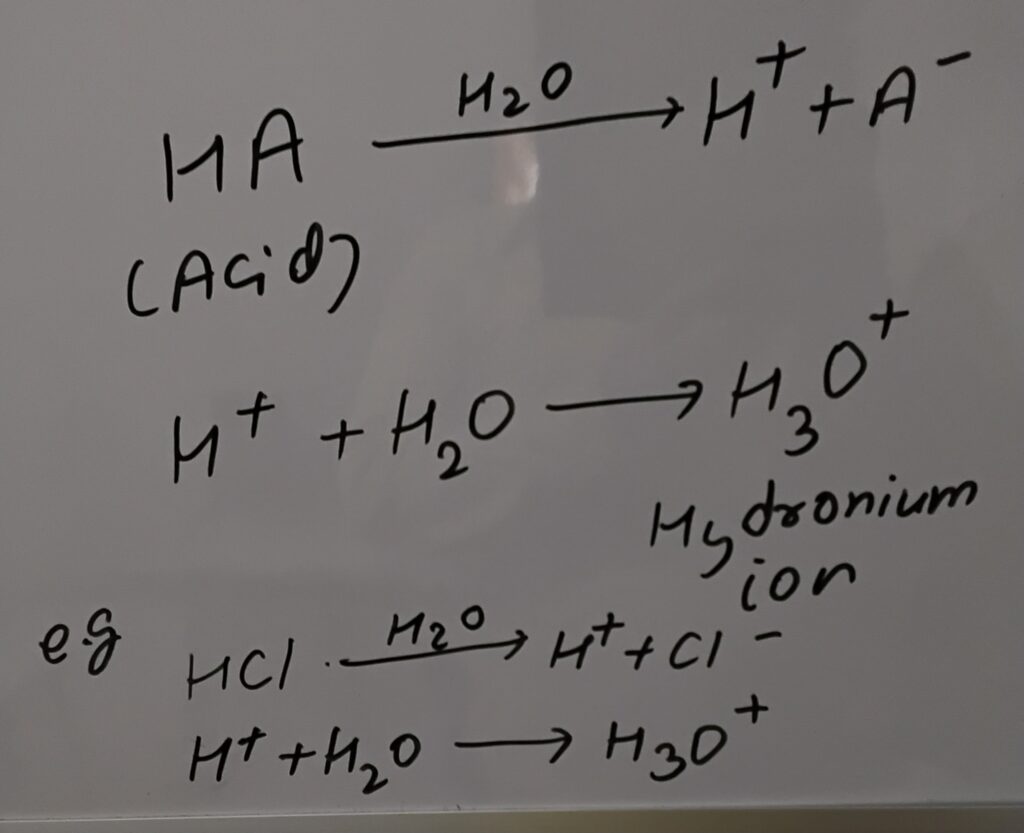
Q. Explain the formation of Hydronium ion(H3O+).
Ans. When acid is added to water , it splits into ions. Acid gives hydrogen ion(H+) which combine water(H2O) to form hydronium ion.
……note….
When diluting an acid, it’s always safer to add the acid to water, and not water to acid, because the reaction between the two is highly exothermic, if you add water to acid, the concentrated heat generated can cause the solution to boil violently, potentially splashing dangerous acid out of the container. So add acid to water with continuous stirring.
Q. Define neutralization reaction.
Ans. Acid react with base to form salt and water, this is called neutralization reaction.
Acid +Base————->Salt+Water.
HCl+NaOH———>NaCl+H2O
H2SO4+KOH———–>K2SO4+H2O
………note……important concepts & reactions……
- Acid/base+Metal———>Salt+ hydrogen gas
- 2NaOH+Zn——–>Na2ZnO2+H2 Na2ZnO2 is sodium zincate.
- Metal carbonate/bicarbonate +Acid———->Salt+CO2+H2O, this reaction make lime water milky Ca(OH)2+CO2—————->CaCO3+H2O, CaCO3 is white ppt.
- Na2CO3+2HCl————>2NaCl+H2O+CO2
- NaHCO3+HCl————->NaCl+H2O+CO2
- Acid and base dissociate into ions in water, so solution of Acid and base conduct electricity. Electrolyte are compounds which provide ions to solution. Solution of starch and glucose do not conduct electricity as they do not dissociate into ions.
- HCl———-H2O——–>H+ +Cl- NaOH——-H2O—–>Na+ +OH- . Acid provide H+ ion which is also called proton, which react with water to give hydronium ion (H3O+). Base gives hydroxide ion (OH-) in water.
- CaCO3 +H2O +CO2—————->Ca(HCO3)2(aq). When excess CO2 is passed over moist CaCO3 is Calcium bicarbonate is formed.
- Metal oxides are basic so they react with acid to form salt and water. Metal oxide+Acid——>Salt+water
Q. What do mean by Ph value?
Ans. Ph value of a solution represents the concentration of hydronium ion or hydrogen ion in the solution. Ph value is inversely proportional to the concentration of H+ or H3O+. Higher the concentration of H+ , lower will the Ph value and more acidic will be the solution. Lower the concentration of H+ or H3O+ , higher will be the value of Ph less acidic or more basic will be the solution.
Ph value<7 is acidic solution
Ph value>7 is basic solution
Ph value=7 is neutral solution